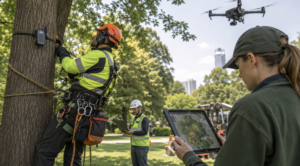
New York has never been a simple place to build. Dense neighborhoods, aging infrastructure, complicated logistics, strict safety requirements, limited staging space, rising costs, and enormous public and private projects make construction in the city unlike construction almost anywhere else in the country. Today, another factor is changing the industry just as dramatically: technology.
Construction management is moving far beyond clipboards, printed schedules, stacks of drawings, and weekly progress meetings. Digital project platforms, real-time field reporting, Building Information Modeling, cloud-based document management, mobile applications, drones, data analytics, and connected jobsite systems are becoming increasingly important to the way New York projects are planned and delivered. 🏗️
The basic purpose of construction management remains the same. According to Wikipedia’s overview of construction management, the profession applies project-management techniques to planning, design, and construction while managing such critical factors as scope, time, cost, and quality. What is changing is the amount of information managers can access and how quickly they can act on it.
For developers, owners, contractors, architects, engineers, and public agencies across New York, better information can translate into faster decisions, improved coordination, stronger cost control, and fewer surprises once construction begins.
Technology Is Changing the Construction Manager’s Role 🏙️
A construction manager has traditionally served as the central link between owners, designers, contractors, subcontractors, vendors, inspectors, and other stakeholders. That responsibility has not disappeared. Instead, technology has expanded it.
Modern project managers may now oversee digital drawings, scheduling platforms, procurement databases, safety documentation, photographs, inspection records, change orders, budgets, requests for information, and field reports from a single connected environment. Information that once moved from the jobsite to the office over several days can now reach decision-makers almost immediately.
That speed matters in New York. A delayed delivery, missed inspection, unresolved drawing conflict, or scheduling mistake can affect multiple trades and create expensive downstream problems. Managers who can see developing issues early have a greater opportunity to correct them before they disrupt the larger schedule.
Professional Construction Project Management New York services are therefore becoming increasingly valuable for owners attempting to coordinate complicated projects while maintaining control over schedules, contractors, documentation, budgets, and quality.
Technology does not eliminate the need for experienced management. It gives experienced managers better tools with which to work.
Digital Permitting Is Becoming Part of the Building Process 💻
New York City’s regulatory environment is another reason construction technology has become so important. Projects often require numerous filings, approvals, permits, inspections, and supporting documents before work can proceed through different stages.
The New York City Department of Buildings states that most construction requires a DOB permit and that applications must be submitted for review to establish compliance with the Building Code. The agency has also continued moving construction filings from paper-based processes toward electronic systems such as DOB NOW.
That transition affects much more than paperwork. Digital permitting makes regulatory information increasingly accessible to project teams and places greater importance on accurate electronic records.
Construction managers can organize filings alongside schedules and project milestones rather than treating permitting as an isolated administrative process. A pending approval can be tied to procurement dates, mobilization, inspections, subcontractor scheduling, and other tasks dependent on that approval.
For New York projects operating under tight timelines, that type of coordination can be critical.
Building Information Modeling Is Bringing Projects to Life Before Construction Begins 🏢
One of the most important technological developments in construction has been Building Information Modeling, commonly known as BIM. Instead of relying solely on two-dimensional drawings, BIM allows teams to work with detailed digital representations of buildings and construction conditions.
New York City has incorporated the technology into its own construction processes. The NYC Department of Buildings’ 3D Site Safety Plans program uses BIM software to enable electronic filing of site safety plans. The system allows examiners to view projects in three dimensions, better understand building complexities, identify potential safety issues, and improve communication during the review process.
For project managers, the value of three-dimensional modeling begins well before workers arrive on site.
Design conflicts can sometimes be identified digitally rather than discovered during installation. Mechanical, electrical, plumbing, structural, and architectural systems can be reviewed together. Equipment locations can be evaluated. Construction sequencing can be planned with greater clarity. Site logistics can be visualized before temporary structures, cranes, material-storage areas, or access routes are established.
On a New York jobsite where space may be extremely limited, planning the physical movement of people, materials, and equipment can be every bit as important as planning the building itself.
Construction Data Is Becoming a Management Resource 📊
Construction projects generate extraordinary amounts of information. Until recently, much of that information remained scattered across spreadsheets, paper files, email accounts, photographs, drawings, and individual departments.
Connected technology is turning that information into usable project data.
New York City itself demonstrates the enormous scale of available construction information. The DOB NOW Build Job Application Filings dataset available through NYC Open Data contains information from Department of Buildings filings and is updated regularly.
For construction professionals, the broader trend is significant. Data can help managers compare actual progress with scheduled progress, monitor budget changes, document site conditions, identify recurring delays, evaluate subcontractor performance, and maintain a record of decisions throughout a project.
Historical information can also become valuable on future projects. If previous jobs reveal that certain activities routinely require longer lead times or that particular project phases generate repeated change orders, managers can incorporate those lessons into future planning.
Construction management is gradually becoming both a building discipline and an information discipline.
New York’s Construction Market Makes Efficiency More Important 💰
Technology is becoming more valuable at the same time that New York continues to manage an enormous volume of construction.
The New York Building Congress projected approximately $74 billion in New York City construction spending for 2025 in its 2025–2027 Construction Outlook, with activity spanning residential projects, office construction, infrastructure, renovations, and other development. The report also highlighted continuing pressures from construction costs, financing conditions, and material expenses.
Those pressures place even greater importance on disciplined project management.
When budgets are large, even relatively small percentages of waste or delay can represent substantial amounts of money. Accurate forecasting, procurement planning, cost tracking, change management, and schedule control become essential.
Digital dashboards can give stakeholders a clearer view of project status. Updated schedules can make delays visible sooner. Centralized documentation can reduce confusion about which drawing or specification is current. Mobile reporting can provide management teams with direct information from the field.
The objective is not simply to collect more data. The objective is to turn information into decisions that protect the project.
Infrastructure Projects Are Driving Better Project Delivery 🚇
Building technology is not limited to commercial towers and residential developments. Some of New York’s largest technology-driven management challenges are found in transportation and public infrastructure.
The Metropolitan Transportation Authority’s 2025–2029 Capital Plan describes the use of comprehensive analysis in determining system needs and discusses the role of its consolidated Construction & Development organization in project management and construction delivery. The plan reflects the extraordinary challenge of improving a massive transportation network while much of that network continues operating around the clock.
That challenge illustrates why sophisticated project management matters throughout New York.
Infrastructure work may involve multiple agencies, engineering disciplines, contractors, funding sources, neighborhoods, operating systems, and regulatory requirements. Work must frequently be sequenced around existing transportation operations and public access.
Digital scheduling, asset information, project controls, collaborative design systems, document management, and real-time communication give teams additional tools for coordinating that complexity.
The lessons learned on major infrastructure programs increasingly influence private construction as well. Owners expect clearer reporting, more transparent scheduling, improved documentation, and faster access to project information.
Mobile Technology Is Connecting the Office and the Jobsite 📱
Construction has always faced an information gap between the people planning work and the people performing it. Mobile technology is narrowing that gap.
Superintendents and field personnel can record conditions directly from the jobsite. Photographs can be attached to reports. Drawing revisions can be distributed electronically. Punch-list items can be assigned and tracked. Inspection information can be recorded without returning to an office trailer to complete paperwork.
That creates a more continuous flow of information.
A project executive working from an office can review progress information from the field. A designer can receive documentation of an unexpected condition. A subcontractor can see an updated drawing. An owner representative can review progress without waiting for the next formal meeting.
None of these capabilities removes the need for personal communication. Construction remains a relationship-driven industry. Technology simply gives those conversations better information.
Safety Management Is Becoming More Data-Driven 🦺
Technology also has an increasingly important role in construction safety.
Digital safety inspections, mobile checklists, photographic documentation, training records, incident tracking, wearable technology, cameras, sensors, and site-monitoring systems can all contribute to a more organized safety program.
The Occupational Safety and Health Administration emphasizes that effective construction safety programs depend on management involvement, employee participation, worksite analysis, hazard prevention, control measures, and training.
Technology can strengthen those activities when it is used properly.
A manager can document recurring hazards, review inspection history, monitor corrective actions, and confirm that identified problems have been addressed. Digital records can also make safety information easier to distribute across large projects involving numerous contractors and crews.
In New York’s dense urban environment, construction safety extends beyond workers. Pedestrians, neighboring properties, traffic, adjoining buildings, and public spaces may all have to be considered. Strong project planning must account for those conditions from the beginning.
Cloud-Based Collaboration Is Reducing Information Silos ☁️
Large construction projects can involve hundreds of participants. Problems arise when those participants work from different versions of the same information.
One contractor may have an outdated drawing. Another may not have received a revised specification. An owner may be reviewing an old budget. A field team may not know that a design change was approved earlier in the day.
Cloud-based project platforms are helping reduce these information silos by creating a central location for project documents and communication.
When managed effectively, a connected project environment establishes clearer records of revisions, approvals, responsibilities, deadlines, and decisions. That becomes particularly important when a project experiences disputes, schedule impacts, design changes, or unexpected conditions.
Good documentation has always been important in construction. Digital systems make it possible to create that documentation continuously rather than reconstructing the project history after a problem occurs.
Technology Is Improving Cost and Schedule Control ⏱️
Two of the biggest concerns on almost every construction project are cost and time.
Digital project controls allow managers to connect schedules, budgets, contracts, procurement information, and field progress more closely than traditional standalone systems.
If a critical material is delayed, managers can examine which activities depend on its arrival. If a design change affects several trades, its cost and scheduling implications can be evaluated together. If field production falls behind expectations, management can identify the variance sooner and determine whether resources or sequencing need to change.
The greatest benefit may be earlier visibility.
A problem discovered after it has already delayed several trades is much harder to solve than a problem identified while alternatives are still available. Technology gives project managers a better opportunity to recognize those warning signs.
New York’s construction environment rewards that ability because schedules frequently have little room for error.
Human Expertise Still Determines Whether Technology Works 👷
The growth of construction technology does not mean software is replacing construction professionals.
A digital model cannot negotiate with a contractor. A dashboard cannot determine whether a proposed recovery schedule is realistic. A mobile app cannot replace judgment developed from years of understanding sequencing, trades, logistics, contracts, costs, and site conditions.
The strongest results occur when technology supports experienced people.
A skilled construction manager knows which information matters, when intervention is necessary, which problems can wait, and which problems could jeopardize an entire project. Technology improves visibility, but people still interpret the information and make decisions.
This distinction will become increasingly important as the industry adopts more automation and sophisticated analytical systems. Companies that merely purchase technology will not necessarily outperform their competitors. Organizations that integrate technology into disciplined management processes will have the advantage.
The Future of Building in New York Will Be More Connected 🌆
New York will continue to present some of the most complicated construction challenges in the country. Aging infrastructure must be modernized. New housing must be built. Commercial properties must adapt. Transportation systems must be maintained and expanded. Existing buildings must be renovated for new uses, new technologies, and changing energy expectations.
Managing that volume of work will require more than traditional construction practices.
Projects are becoming connected from planning through completion. Digital permitting connects builders to regulators. BIM connects design with field execution. Mobile technology connects jobsites with offices. Cloud platforms connect owners with project teams. Data analytics connect current performance with future decisions.
The result is a construction industry in which information can move almost as quickly as the project itself.
Conclusion
Construction project management in New York is entering a new era. The fundamentals of successful building remain firmly in place: good planning, experienced leadership, realistic scheduling, cost control, quality workmanship, safety, and clear communication.
What has changed is the technology available to support those fundamentals.
Digital models can reveal problems before construction begins. Connected project platforms can keep teams working from current information. Mobile tools can bring the jobsite directly into the management process. Data can expose trends that once remained buried in paperwork. Electronic regulatory systems can make permitting and compliance increasingly integrated with overall project planning.
For owners and developers, the value of these advancements is practical. Better information creates an opportunity for better decisions, and better decisions can protect budgets, schedules, quality, and long-term project value.
New York has always built upward, outward, underground, and through obstacles that would challenge almost any other city. As technology becomes more deeply embedded in construction management, the next generation of New York buildings and infrastructure will be shaped not only by concrete, steel, glass, and labor, but also by data, digital coordination, and smarter project delivery. 🏗️🗽