
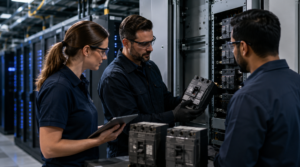
Information technology depends on software, servers, networks, storage, security systems and cloud connections, yet every one of those technologies shares the same basic requirement: dependable electrical power. Behind the racks, switches, cooling equipment and monitoring systems is an electrical infrastructure that has to keep operating day after day.
That reality has put more attention on the physical side of IT. Facility managers are no longer thinking only about processors, bandwidth and storage capacity. They are also watching electrical distribution equipment, replacement-part availability, maintenance schedules and the cost of keeping older infrastructure operating.
According to the U.S. Department of Energy, data centers are among the most energy-intensive types of buildings, using significantly more energy per square foot than a typical commercial office building. That makes electrical infrastructure more than a background concern. It is part of the operating foundation of modern IT.
For facilities that use compatible Siemens equipment, sourcing a B320 Used circuit breaker can be one practical option when an exact replacement is required. The B320 is a Siemens three-pole, 20-amp, 10K@240VAC bolt-on circuit breaker intended for compatible electrical equipment.
The growing interest in replacement electrical components reflects a larger trend across IT facilities: organizations want reliability, but they also need to control costs, extend the useful life of existing infrastructure and avoid unnecessary delays when equipment requires service.
Power Reliability Has Become an IT Issue
A generation ago, many organizations could draw a fairly clear line between the IT department and the people responsible for the building. That line is becoming harder to see.
Modern IT facilities contain an interconnected collection of systems. Servers depend on cooling. Cooling depends on electrical power. Networking equipment depends on power. Security controls, monitoring equipment, storage systems and backup systems all depend on the electrical infrastructure supporting the facility.
IBM’s overview of modern data centers describes the data center as the physical facility housing the IT infrastructure needed to build, run and deliver applications and services. That definition matters because it places the physical building and its infrastructure directly within the broader technology environment.
A circuit breaker may appear far removed from software applications running inside a server rack, but an electrical distribution problem can quickly become an IT operations problem.
That is why facilities teams increasingly treat electrical maintenance as part of business continuity rather than routine building maintenance.
The Economics of Maintaining Existing IT Facilities
Replacing an entire electrical system every time an individual component reaches the end of its useful service life makes little financial sense. Many commercial and industrial facilities contain equipment designed to remain in service for years, provided it continues to meet the requirements of the application and is properly maintained.
This creates a significant replacement-parts market.
Facility managers may have a perfectly serviceable panel or distribution system that requires one particular breaker. The challenge becomes finding the correct part rather than replacing a much larger section of infrastructure simply because a component is difficult to source.
For IT facilities operating under tight capital budgets, that distinction matters.
A targeted replacement may help an organization preserve existing infrastructure while directing capital toward projects that deliver greater operational value, such as server upgrades, cooling improvements, cybersecurity, network expansion or additional redundancy.
The approach also recognizes something that experienced facilities professionals already understand: newer is not automatically synonymous with more appropriate. Electrical equipment has compatibility requirements. A replacement needs to match the system in which it will operate.
The B320, for example, has specific characteristics including its Siemens design, three-pole configuration, 20-amp rating, bolt-on mounting method and 10K@240VAC rating. Those specifications need to match the intended application.
Used Components Can Help Solve Replacement-Part Availability Problems
Cost is only part of the reason organizations consider used electrical equipment. Availability can be just as important.
IT facility downtime does not conveniently wait for a purchasing department to locate a newly manufactured component. Older installations can present sourcing challenges, particularly when equipment has been operating reliably for many years and the original product line has changed.
A secondary market for electrical components gives maintenance professionals another sourcing channel.
That does not mean every used breaker belongs in every facility. It means a properly identified used component can become a valuable option when the existing system requires that particular model and the component is obtained from an appropriate supplier.
The broader philosophy fits naturally with the way many IT departments already manage hardware. Organizations regularly evaluate whether an existing server, switch, storage device or supporting system should be repaired, upgraded or replaced based on condition, compatibility, cost and operational requirements.
Electrical infrastructure deserves the same disciplined approach.
Reliability Depends on the Entire Facility, Not Just the Server Rack
The importance of infrastructure becomes especially clear when looking at the standards used to evaluate data centers.
The Uptime Institute Tier Classification System evaluates data center infrastructure according to factors that include power, cooling, maintenance capability and fault tolerance. Its Tier III classification, for example, emphasizes the ability to maintain or replace components without shutting down IT operations.
That provides useful perspective even for facilities that are not seeking formal Tier certification.
Reliability is rarely created by one spectacular piece of technology. It comes from many individual components doing their jobs correctly and from a facility being designed and maintained so that serviceable parts can be addressed before they become larger operational problems.
Electrical panels and circuit breakers are part of that chain.
The same principle appears in Wikipedia’s overview of data centers, which describes power supply, networking, environmental controls and security as important elements of data center design and notes the role of redundant or backup components in supporting business continuity.
IT reliability therefore extends from the application layer all the way down to the physical equipment supplying power.
The Growth of AI Is Putting Even More Attention on Facility Power
Artificial intelligence has made the relationship between computing and electricity impossible to ignore.
AI workloads can require substantial computing resources, and the facilities supporting those workloads have become a major subject across the technology and energy industries.
The U.S. Department of Energy’s discussion of data center electricity demand notes that expanding data center deployment, including infrastructure supporting AI applications, is contributing to near-term electricity demand growth. The agency also emphasizes the importance of reliability and affordability as data center power requirements expand.
That growth changes the conversation around IT facilities.
Power is becoming a strategic technology resource.
An organization may spend millions of dollars on computing capability, but those systems still depend on breakers, panels, transformers, generators, UPS equipment, cooling systems and other physical infrastructure.
As computing density rises, facilities departments and IT departments have even more reason to coordinate maintenance decisions.
Older Infrastructure Is Not Automatically Obsolete Infrastructure
Technology has trained people to expect rapid replacement cycles. Phones change every year. Servers evolve quickly. Software may receive updates every few weeks.
Commercial electrical infrastructure operates on a different timeline.
A facility can contain electrical equipment that has performed reliably for many years while the computing technology connected to it has gone through several generations.
That creates an important distinction between obsolete technology and serviceable infrastructure.
A panel does not necessarily need replacement merely because it is older. Its condition, suitability, capacity, maintenance history and compatibility with current requirements are more meaningful considerations. Decisions involving electrical equipment should be made by qualified professionals who can evaluate the actual installation.
The ability to source an exact replacement component may allow a facility to address a specific maintenance requirement without immediately undertaking a larger electrical modernization project.
That can be particularly valuable for organizations managing multiple buildings, branch offices, server rooms, warehouses, telecommunications spaces or distributed IT operations.
Maintenance Planning Matters More Than Emergency Purchasing
The worst time to begin researching a difficult-to-find breaker is after equipment has failed.
Progressive IT facilities are increasingly applying inventory management principles to critical infrastructure. Maintenance teams can document panel information, breaker models, equipment specifications and replacement requirements before an emergency develops.
That information makes future purchasing faster and more accurate.
It also reduces the temptation to select a component simply because it appears similar.
Circuit breakers are designed for specific electrical systems. Pole configuration, amperage, voltage, interrupting rating, manufacturer requirements and mounting design all matter. The B320 product information itself emphasizes verifying those characteristics against the panel, equipment requirements or project specifications before installation.
Maintaining accurate facility records can therefore become a surprisingly important part of IT resilience.
Asset inventories should not end at laptops, servers and switches. Organizations with critical on-premises infrastructure benefit from knowing what supports those devices electrically as well.
Critical Facilities Are Built Around Layers of Protection
Reliable IT environments rarely depend upon a single safeguard.
The National Institute of Standards and Technology report on resilience for critical facilities discusses the extensive mechanical and electrical systems used in data centers and highlights the importance of uninterrupted power supplies, cooling and redundancy.
Those layers work together.
Utility power supplies the facility. Distribution equipment moves electricity where it is required. Circuit protection helps protect electrical circuits. UPS systems help bridge certain disruptions. Generators can support facilities during longer utility outages. Cooling keeps operating temperatures within acceptable ranges.
None of those systems operates in isolation.
That is why something as ordinary-looking as a circuit breaker can have real operational importance inside an IT facility.
Cost Control Does Not Mean Cutting Corners
Saving money on facility maintenance works only when the savings do not introduce unnecessary risk.
Used electrical equipment should never be treated as a shortcut around compatibility, inspection, maintenance practices or professional installation. The goal is to obtain the correct component at an appropriate cost, not simply to locate the least expensive breaker available.
Facility managers should verify the exact part number and electrical specifications, confirm compatibility with the equipment, consider the condition and source of the replacement component, and rely on qualified electrical professionals for installation and evaluation.
That disciplined approach separates intelligent cost control from indiscriminate cost cutting.
A $65 component that correctly solves a replacement need can represent smart purchasing. A mismatched component that creates additional downtime or requires another service call can become far more expensive than its purchase price suggests. JDM Supply currently lists its used Siemens B320 at $65, although pricing and availability can change.
For IT operations, total cost includes labor, delays, downtime, procurement effort and the effect a maintenance problem has on the systems employees and customers rely upon.
IT Facilities Are Becoming More Strategic About Replacement Parts
The larger trend goes beyond one breaker model.
IT facilities are becoming more deliberate about the physical infrastructure supporting digital operations. Companies are evaluating redundancy, energy efficiency, cooling capacity, electrical distribution, spare parts and maintenance readiness alongside traditional technology investments.
That is a healthy development.
The servers may attract the attention, but the facility keeps them alive.
When a compatible existing electrical system can remain in service through the proper replacement of a specific component, used equipment can provide another tool for facility managers balancing reliability and cost.
It is an especially practical strategy when organizations know their equipment, maintain accurate records and source exact replacement models rather than attempting to make unsuitable components work.
Conclusion
The modern IT facility is no longer simply a room filled with computers. It is an interconnected environment where computing, electrical power, cooling, networking, security and facility management all contribute to uptime.
As data centers and other technology-intensive facilities consume more electricity and support increasingly important workloads, attention is shifting toward the infrastructure behind the technology. Organizations are looking for ways to keep proven systems operating while controlling maintenance expenses and avoiding unnecessary replacement projects.
Used circuit breakers can fit into that strategy when the exact component matches the application and is properly selected, evaluated and installed. For facilities using compatible Siemens equipment, the B320 provides an example of how a specific replacement component may help solve a maintenance requirement without forcing a much larger infrastructure change.
The lesson for IT facilities is straightforward. Reliability does not begin at the server. It begins with the systems that allow the server to stay running.
Well-managed facilities understand that distinction, plan for replacement needs before emergencies arise and make purchasing decisions based on compatibility, condition, reliability and total operating cost. As IT infrastructure continues to expand, those practical decisions behind the scenes will become even more important to keeping the digital world online.